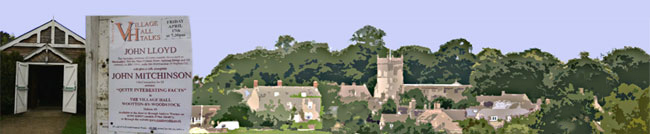

The project was conceived to raise funds to renovate the village hall in Wootton-by-Woodstock, which was built almost entirely from timber over eighty years ago. Few who have attended the talks would disagree that the evenings have been an engaging mixture of serious insight and comedic observation and we think we are catering for the current thirst for live events in smaller venues.
|
The Nicholas Cleobury Talk
 |
|
For many musicologists, Benjamin Britten is given the same genius tag as John Dowland, Henry Purcell and Edward Elgar - but to others, his music is seen as lacking in memorable melodies and quite dour. But Nicholas Cleobury, in his wonderful talk on May 3rd, made a convincing case that Britten was, indeed, a towering musical force who had put 20th Century English music on the world map.
This year is the centenary of Britten's birth and there is a global celebration of his work, with Nicholas - one of the country's most respected conductors - the artistic director of Britten in Oxford, a year-long festival of concerts and lectures.
Nicholas's talk began with an interlude from Britten's opera, Peter Grimes, which captured the movement and melancholy of the sea - a theme which featured in much of his work, having been born in Lowestoft (the son of a dentist) and spending countless hours exploring the Suffolk coast. In fact, it was after first hearing Frank Bridge's piece, The Sea, in 1927 that Britten later said he was "knocked sideways". He would go on to study composition with Bridge.
Nicholas pointed out that, even as young boy, Britten composed over 800 works and he would go on to write in many genres, including operas, choral music, film scores and pieces like The Young Person's Guide to the Orchestra, highlighting a diversity which led to him being labelled the "People's Composer".
International success, Nicholas told us, came with the premiere of Peter Grimes in 1945 and - over the next nine years - he would write six more operas, which cemented his position in 20th Century music.
He also wrote orchestral and chamber works, as well as music for children and amateur performers, and also solo vocal - much of written for his life-partner, the tenor, Peter Pears. Nicholas suggested that Pears possessed supreme vocal gifts and, in some cases, he alone was capable of singing the pieces Britten had written - creating a unique vocal texture.
Whilst some Oxford music professors have claimed Britten is overrated, Nicholas is adamant he was a genius and that his ability to write music for words is without parallel. This was evident even in apparently simple pieces, like the music to accompany W.H. Auden's poem, Night Mail, when they were both working for the GPO Film Unit.
Indeed, he had travelled to New York with Auden and immersed himself in the gay bohemian life there. But it wasn't to his taste and he soon returned to England - living quite an ambivalent existence in a country where homosexual activity wasn't legalised until 1967.
Despite seeing Britten as a majestic figure, Nicholas recognised that he was a complex man, who could be waspish and "drop" people for no apparent reason. From a very young age, he despised cruelty to both humans and animals - and his plea to be a conscientious objector during World War II (which succeeded) was based on his refusal to countenance killing.
But his devotion to Pears never wavered and he always placed him on a pedestal as the overriding inspiration for his work. This was confirmed in two letters, read by Nicholas, which the men sent to one another when Pears was performing in Britten's opera, Death in Venice in New York - both full of a deep mutual affection.
Britten and Pears developed the festival in Aldeburgh, in Suffolk, where they lived, and it later moved to nearby converted Victorian buildings at Snape - now considered one of the finest concert halls in the country.
Marlene Fisher's back-drop at the talk featured Maggi Hambling's pair of interlocking metal scallop shells, four metres high, sitting on the beach between Aldeburgh and Thorpeness - raised as a tribute to Britten. The corrugated steel is pierced with the words "I hear those voices that will not be drowned" - taken from Britten's opera, Peter Grimes.
I thought that maybe the music of Benjamin Britten wasn't one for me - but Nicholas's talk proved a revelation and I shall now return to the music with new ears. As well as highlighting his musical achievements, Nicholas detailed the key places and people in Britten's life, which proved such an important catalyst. A wonderful, illuminating talk, delivered with supreme skill - Tony Clouston, Stratford-upon-Avon.
|
 |
|
 |
WILL GOMPERTZ
Friday May 31st 2013
Will is the BBC's Arts Editor - the first person appointed to the role - and regularly appears on the nation's television screens discussing major stories. He was previously director of Tate Media at Tate Modern for several years and has written extensively about the arts in The Times and The Guardian.
Will recently published What Are You Looking At?: 150 Years of Modern Art in the Blink of an Eye - an accessible and enlightening history of modern art spanning Impressionism to the present day. The book, published by Penguin, is aimed at sceptics and art lovers alike and cuts through pretentious art speak that often surrounds the art world. In its review, The Guardian said that Will had written "an energetic and comprehensive romp through modern art, starting unusually in the 19th Century and continuing right up to Ai Weiwei".
Will appeared in a show at the Edinburgh Fringe in 2009 called Double Art History and also in an episode of the BBC's Have I Got News For You in November 2012, hosted by Jeremy Clarkson.
He lives in Oxford with his wife, Kate, and their four children. His second cousin is Simon Gompertz, a familiar voice on BBC News where he is personal finance correspondent.
If you are interested in attending this talk, there are usually some returns as the date of a talk approaches. To go on the reserve list please Contact us |
| |
|
|
 |
PADDY ASHDOWN
Wednesday June 26th 2013
Paddy is a former leader of the Liberal Democrats and the international community's High Representative in Bosnia and Herzegovina and now sits in the House of Lords. He was also a member of the Royal Marines' elite Special Boat Service, which was formed as a result of Operation Frankton - the legendary wartime commando raid on German shipping when the men involved became known as the "Cockleshell Heroes".
Paddy had always been fascinated by this classic story of bravery and ingenuity, and, after consulting previously unseen archives and tracking down surviving witnesses, he wrote a fascinating narrative of this daring mission.. The book, called A Brilliant Little Operation, was published on the 70th anniversary of the operation and he will speak about the raid during his talk in Wootton.
Paddy's research confirmed that the real story of the raid was far more controversial than previously thought - in fact, a tale of Whitehall rivalry and communication breakdown, which probably led to some of the men losing their lives unnecessarily – and serves only to make the achievements of the "Cockleshell Heroes" all the more impressive.
Ironically, as a young man, Paddy had found himself on a train being politely interrogated about his time in the Special Boat Service by an elderly white-haired man. Only after the end of the journey did he discover that this would be his only encounter with "Blondie" Hasler, one of his all-time heroes, and leader of the "Cockleshell" raid.
The mission's background was that in 1942, before El Alamein turned the tide of war, the German merchant fleet was re-supplying its war machine with impunity. Operation Frankton, a daring and secret raid, was launched by Mountbatten’s Combined Operations and led by the enigmatic Hasler – to paddle "Cockleshell" canoes right into the occupied Bordeaux harbour and sink the ships at anchor, using limpet mines.
It was a desperately hazardous mission from the start – dropped by submarine in open sea, surviving terrifying tidal rips, only to face the biggest challenge of all, escaping to freedom on an epic route across the Pyrenees. Fewer than half the men even made it as far as Bordeaux; only four laid their mines and just two got back alive. But far greater than the damage caused to the nine ships they partially sank was the immense blow struck at the Germans’ sense of impregnability.
If you are interested in attending this talk, there are usually some returns as the date of a talk approaches. To go on the reserve list please Contact us |
| |
|
|
 |
MATTHEW RICE
Friday July 26th 2013
Matthew is an acclaimed writer, illustrator and designer whose latest book, published in July, is called Rice's Church Primer and is a beautifully illustrated introduction to the architectural and interior features of British churches.
It is the follow-up to his well-received work, Rice's Architectural Primer.
Matthew has written for Country Life magazine and he also illustrated his own calendar. His designs have also appeared on the pottery of his wife, Emma Bridgewater.
Matthew left the bespoke furniture business he set up with David Linley, the son of Princess Margaret, to join Emma's business. They work closely together on designs for a diverse range of teapots, mugs, plates, bowls and cookware, as well as tinware such as trays, cake tins and biscuit barrels. The business generates a turnover of £14 million. - making it the largest pottery manufacturer based solely in the UK.
If you are interested in attending this talk or would like to reserve a ticket please Contact us |
| |
|
|
|
| |
|
|
|
Local Links
The Woodstock Bookshop
Adrian Arbib Photography
Wootton Stores - The Village Shop
Robin Laurance Photography
The Killingworth Castle
Ashmolean Museum
The Bodleian Library - Exhibitions and Events
U3A - Woodstock University Of The Third Age
|